Floor Layout Carpet Psychology: Spatial Traps for Table Players
Casino floor managers do not spend six figures on custom carpet because it looks expensive — they spend it because that woven surface is a behavioral control grid that steers your wallet before you ever touch a chip. The carpet under your feet is a psychological instrument, and once you understand how it warps spatial decision-making, you cannot unsee the manipulation.
Walk into any serious gaming hall and watch what happens at the threshold. The carpet pattern shifts from high-contrast, busy geometry near the entrance to soft, low-contrast swirls deeper in the pit. That transition is not decorative taste — it is a neurological softener. High-contrast patterns trigger alertness and faster reaction times, which is exactly what you want in a lobby where security needs to spot trouble. Low-contrast, flowing motifs lower cognitive resistance and slow your walking cadence. Every meter you drift inward, your guard drops another notch. 😶
The Winding Path Principle and Slot Alley Geometry
Straight aisles are a disaster for gaming revenue. A player who can see a direct exit line from the pit walks it. Designers solve this with curved carpet pathways that bend around banks of machines and table clusters, and the numbers behind this are brutal. A route that forces a 30-degree course correction adds roughly 18 to 24 seconds of dwell time per traversal. Repeat that across a three-hour session and you have engineered nearly forty extra minutes of exposure — and exposure is where the money lives.
Those curves also create what floor planners call the "veil effect." When your sightline to the exit is broken by a carpet pattern that flows diagonally rather than straight ahead, your brain registers the space as deeper than it actually is. You feel like you are still in the middle of the action even when you are two rows from the door. That false depth perception keeps casual players circulating far longer than they intended.
Color Temperature as a Bet Sizing Trigger
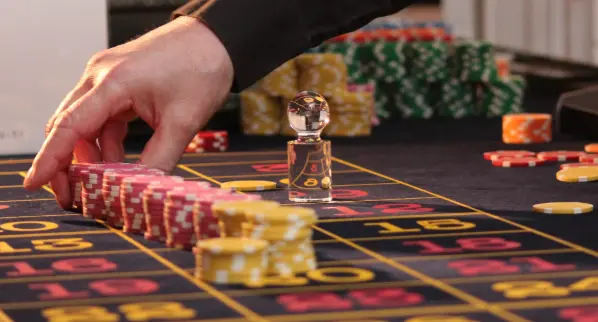
Here is where the carpet psychology gets genuinely predatory. Deep reds and warm crimsons woven into the carpet beneath table games correlate with measurably larger average bet sizing. The mechanism is arousal transfer — warm hues raise physiological excitation, and players misattribute that elevated heart rate to confidence rather than environment. Pit bosses know this. That is why the baccarat and high-limit zones almost universally sit on crimson and gold carpet fields while penny machines get cool blues and greens that calm rather than excite.
Cool-toned carpet zones do the opposite job. They suppress impulsive decision-making, which sounds player-friendly until you realize it is aimed at grinders who need to stay sedated and seated for hours on low-denomination play. The house does not want a calm, clear-headed player at a high-stakes table. It wants an aroused one who reads his own adrenaline as a hot streak. Floor layout carpet psychology is not about comfort — it is about controlling your physiological state at the exact moment money moves.
Anchor Points and the Illusion of the Shortest Route
Look down at the carpet near any cashier or players club desk. You will usually find a distinct medallion, border, or directional motif radiating outward. These are anchor points, and they function as subconscious waypoints. Players navigating a casino floor rely on floor-level visual cues far more than overhead signage because peripheral vision prioritizes the ground plane for balance and orientation. Designers exploit that hardwiring by placing anchor motifs that pull foot traffic past additional gaming positions rather than directly toward the target.
The trap is elegant: you think you are taking the shortest route to the cage because the carpet told you so. In reality, the route curves past two additional blackjack tables and a progressive bank. Every one of those positions is a fresh decision point, and each decision point carries a probability of engagement. Multiply small engagement probabilities across hundreds of daily footfalls and you get the real reason the carpet cost six figures. 💰

Pattern Density and Table Selection Bias
Dense, intricate carpet patterns under and around table games create visual noise that fragments attention. This is deliberate. Fragmented attention makes it harder to track the dealer's pace, count the shoe, or maintain disciplined bet sizing. The complexity is calibrated to sit just below conscious irritation while still taxing working memory. Studies of table game floors show that players on high-pattern-density carpet make faster, less accurate decisions about when to press a bet — and faster decisions favor the house edge.
Sparse, open carpet fields around poker rooms tell the opposite story. Poker demands sustained analytical focus, so the environment strips away visual clutter to protect deep concentration. The carpet is doing triage on player psychology by game type, and it does it silently, every second, under every foot. The next time you feel a sudden urge to move tables or press a bet, glance down first. The floor may have made that decision for you.
Wear Patterns as a Tell on Traffic Engineering
Auditors who know what to look for read carpet wear like a ledger. High-traffic lanes show accelerated fiber compression along paths that route past maximum gaming positions. If you see a worn track curving away from the natural sightline to the exit, you have found a deliberately engineered detour. Maintenance schedules that replace carpet sections on a staggered basis are also a tell — the house refreshes the zones that generate the most revenue first, because worn carpet near a high-limit area signals decline and suppresses bet sizing.
Track the wear line from the entrance to the nearest cashier and count how many gaming positions it brushes past. On a genuinely honest floor plan that number stays low. On an optimized revenue floor it climbs, and the carpet under your shoes is the map of every nudge the designers built in.